
Source
Three consumed, frozen image-only pages with independently authored exact source expectations: VNAT page 8, an internal-digit positive, and a digits-and-blank confounder.
Decision report · 11 September 2026
The list ownership correction is unfinished. It stopped before OCR because exact canonical source mappings and the required reconstruction checks were incomplete. No working candidate or recognition gain is demonstrated; production recognition is unchanged.
Gate decision
Unit 43 · In-page list ownership · 11 September 2026
English recognition remains unaccepted. This attempt stopped before OCR because it did not produce a complete, tested candidate. The proposed correction addresses list ownership and projection together, but exact canonical assertion values, source-fragment ranges and the check that reconstructs each item from those references are still missing. The incomplete prototype is retained for inspection; it is not a working recognition result.
The incomplete source changes recognize compound markers, form local list regions and add item-level identities and field assertions. Those changes have not been demonstrated through the actual source conversion path. Parent-support evidence must remain separate from item-owned text; continuation text must sit inside its identified span and retain its style. The required canonical serialization and reconstruction checker were not completed.
The focused synthetic suite stopped after five passes and one failure. The failed assertion checks list serialization and exposes an unordered outer list in that constructed case; changed span markup also differs from the old expected string. This is a failed supporting check, not a measured result on the affidavit or the new source controls. Compilation and diff checks do not establish recognition correctness.
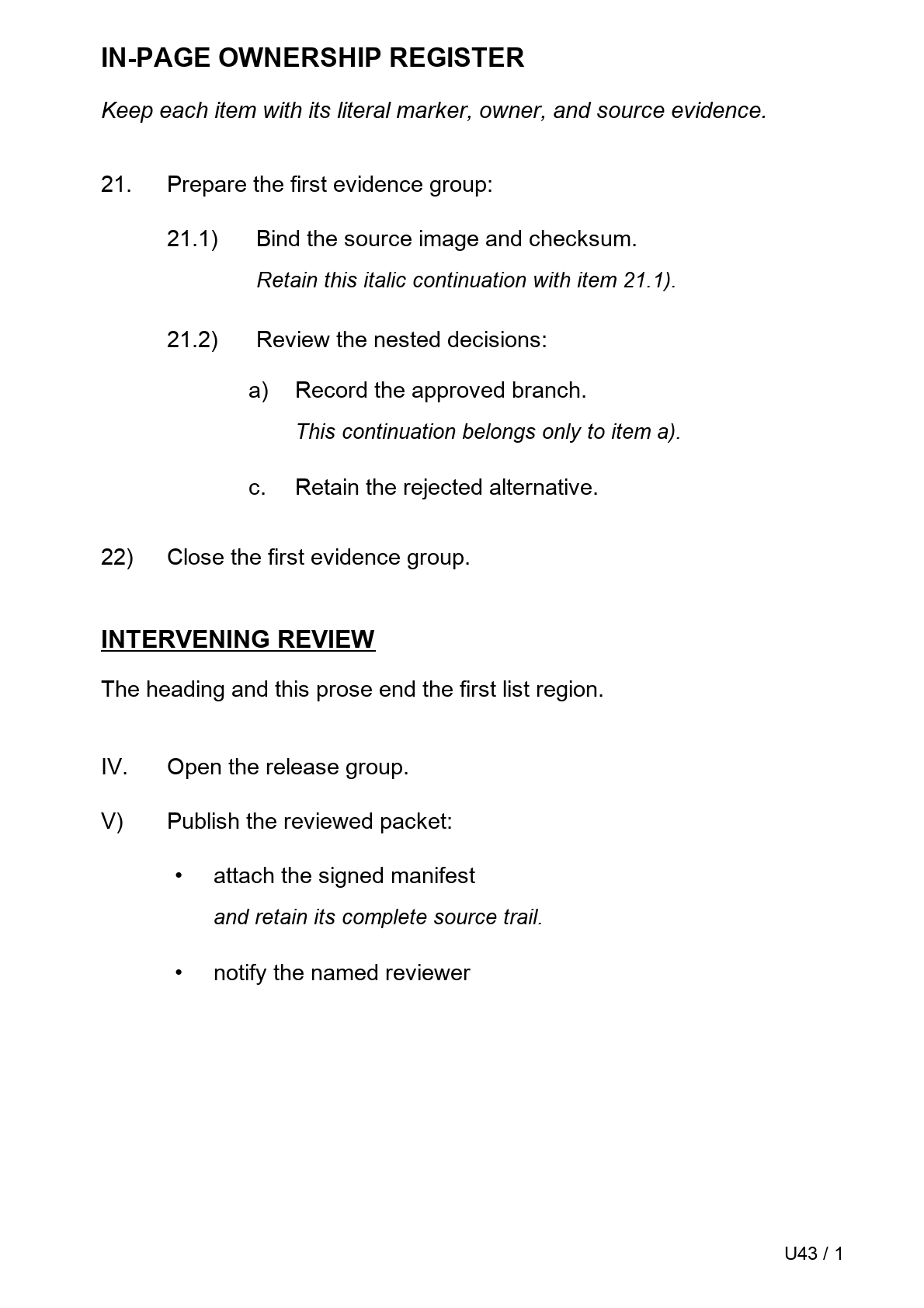
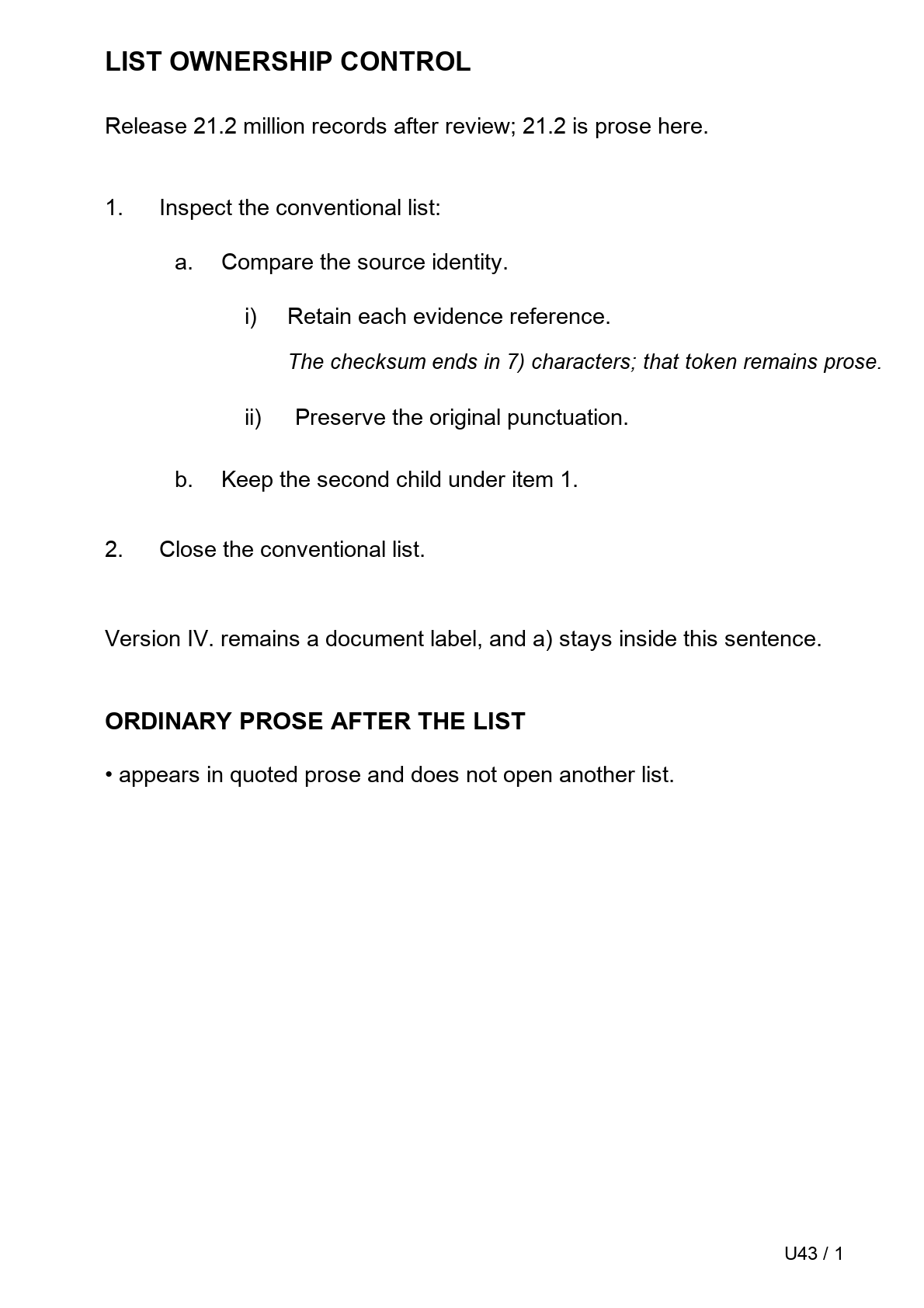
The independently frozen positive source and confounder source cover compound labels, alpha/Roman/bullet kinds, interrupted groups, continuations and marker-like prose. Their whole-line and tokenized observation fixtures require equivalent semantic graphs with exact source coverage. Generated identifiers may differ between representations; parent, kind, text and ownership may not.
The complete independent review records all 46 source objects and 24 meaningful style spans across the three primary pages as unrun, with no candidate mappings or scores. The eight objects in the retained Unit41 grouping source and all four flat/numeric candidate comparisons are also unrun. Historical source failures are kept separate: wrong nesting, the displaced five-part quote, missing 9., C. and page 3, external page-2 parentage, OCR substitutions, paragraph splits, missing furniture and styles.
Fresh independent advice identifies unfinished ownership integration as well as serialization. It supports considering one completion attempt with enough engineering time after this report is verified. That conditional direction does not authorize another trial or promise reliable English within the remaining budget. The final source, failed test, stopped-state and independent-review bindings were recomputed before publication.
Six existing predecessor outputs were rebound to their exact source images, raw observations and imported code. No new predecessor conversion ran. All six planned candidate replays remain unrun, so this reuse supplies no before/after improvement or non-regression claim. Tesseract 5.5.2, English, PSM 3 and PDFium at 216 DPI were retained as the planned configuration but were not invoked in this unit.
9e94f31. No recognition change is accepted or deployed. Missing provider digits, paragraph/order errors, source hierarchy, furniture and styles remain open.Read the complete stopped result, independent review and evidence bindings.
Expected result: an unfinished, unaccepted correction with exact retained evidence and no new recognition measurement.
Unit 42 · Nested-marker scope stop · 11 September 2026
English recognition remains failed. This trial stopped before OCR: an emitter-only correction cannot repair parent relationships that the recognition model never built. The tested prototype preserves the source labels 10., 11. and 12. in a retained-observation replay, while preserving the model’s existing nesting. That nesting is already wrong, so the frozen source criteria cannot pass.
The prototype uses real nested HTML lists with literal label spans, retaining parent/child elements and continuation ownership from the supplied model. It does not change list detection, grouping or OCR. Four earlier controls preserve canonical, human and package bytes exactly, including 4., 7), 12), 19. and numeric prose. Their complete browser images and text are also unchanged.
The complete independent review maps all 15 VNAT source objects and the four earlier controls. The quote owned by 10 remains split into five portions, mostly moved after 11, 12 and a. Source labels 9. and C., printed page number 3 and all 15 meaningful VNAT style spans remain missing. External page-2 parentage, source-object identity, other paragraph boundaries and recorded OCR substitutions remain failed.
The unchanged controls also retain their earlier source errors: joined header regions, missing furniture and styles, missing title roles, and one numeric-prose paragraph split into two. Their byte equality establishes no new difference on these observations; it does not establish complete source fidelity. The two authored nested controls have no output and receive no counterfactual scores.
Ten derived conversions replay five existing provider observations once through each of predecessor 9e94f31 and prototype 8fc6c78. Every fresh input image must exactly match its retained capture; no provider is invoked. These comparisons establish narrow downstream feasibility, not new OCR accuracy. All three planned primary measurements, including the independently authored nested positive and confounder, remain unrun.
Read the complete stopped result, source review and evidence bindings.
Expected result: verified label feasibility with unchanged wrong parentage, a stopped trial and no recognition acceptance.
Unit 41 · Bounded list-order correction · 11 September 2026
The candidate is rejected: it restores numbered text to source order, but newly breaks two valid list relationships in the independent positive. On affidavit page 19, each opening now appears next to its remaining text, with CONCLUSION before paragraph 104. It stops combining nonadjacent list rows across intervening content. The existing continuation threshold and Tesseract settings are unchanged. Each continuation still forms a separate paragraph, so correct sequence does not establish correct paragraph structure.
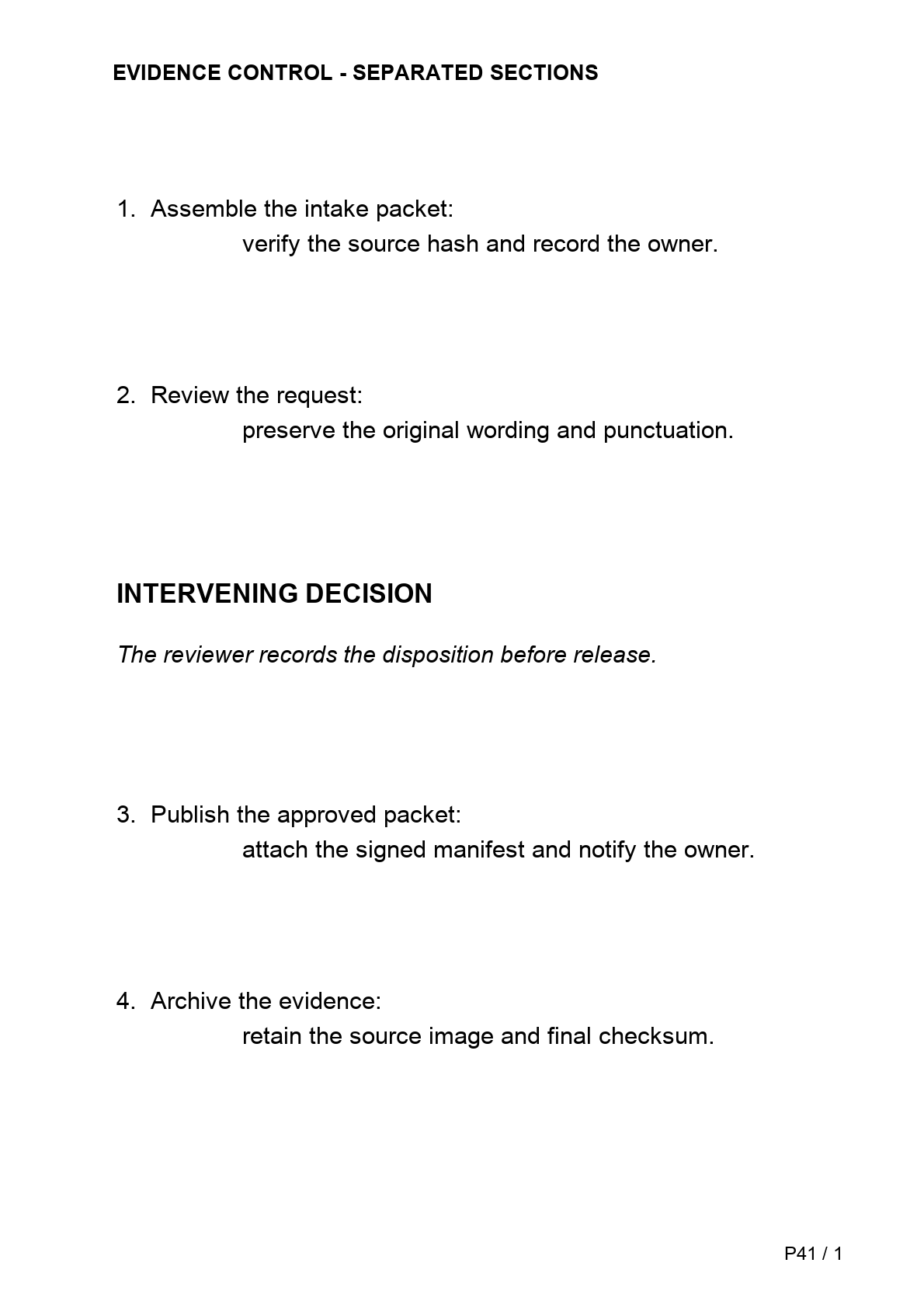
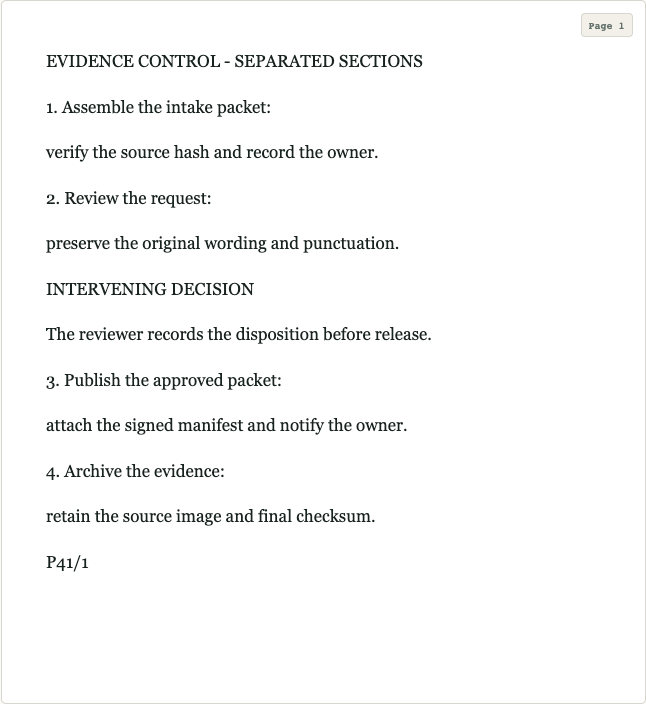
The independent positive has four numbered sections, deeply indented continuations and a real heading and narrative between sections 2 and 3. Those intervening elements now remain in sequence. The genuine contiguous-list control retains one canonical four-item list; its unchanged human projection still uses escaped markers and line breaks rather than a semantic list. The positive source requires items 1–2 to share one list and items 3–4 another. The predecessor wrongly grouped all four together, but still retained both valid within-group relationships. Four candidate singleton lists lose those two relationships. Inspect the independent source and its complete candidate human output.
The independent review maps all 39 source objects to 37 candidate objects: 20 have exact text, 11 are partial and eight are missing. Exact text sometimes requires joining separately emitted fragments and does not mean correct structure. All seven numbered paragraphs remain split. Two positive-case list groups are split into singletons, losing the two valid pair relationships. VNAT also retains two signature joins, 17 wrong source roles across the sample, five furniture-role failures and two unsupported garbage objects.
The missing source objects include six parenthesis-only rows and two commissioner rules. Four signature rules are absent overall; the other two belong to partial objects and must not be counted as additional missing objects. Fourteen closing parentheses, two word spaces in “on the” and four footer spaces across the two “P41 / 1” controls are missing; paragraph 104 gains a false leading quote. All nine meaningful style features across eight spans are absent: six bold, two italic and one underline.
All 222 OCR evidence identifiers remain unique and accounted for. Complete raw, canonical, human, package and browser surfaces were reviewed without excluding source regions. Six derived predecessor/candidate conversions replay the same three captured provider observations with zero new OCR calls; candidate canonical, human and package output exactly match the measured output. This supports attribution of the local order and membership changes, not fresh-provider reproducibility or unseen generalization.
Candidate 0796fd77522f59b06ad730da243b4db8c00fa795 changes list grouping and continuation ownership only. The three once-only product conversions use Tesseract 5.5.2, English, PSM 3 and PDFium at 216 DPI. Three primary OCR calls and six non-inference version/language probes are retained with unique input images, raw TSV, arguments and diagnostics, plus complete canonical, human and package output.
Read the complete result, independent source comparison and evidence hashes.
Expected result: improved visible sequence together with two newly lost list relationships, a rejected candidate and complete failure accounting.
Unit 40 · Complete trigger verification · 11 September 2026
The unchanged candidate fails the wider source comparison. On affidavit page 19, the source and raw OCR place each paragraph's opening before its continuation. Canonical PDFMD and the human view instead collect the openings of paragraphs 102, 103 and 104 before returning to their remaining lines. That ordering damage occurs after raw OCR. The earlier paragraph-body gain does not make the complete document reliable.
For example, the opening ending “provided by the Amended” should continue immediately with “Liquidation Plan is relevant to its validity.” The product inserts the openings of paragraphs 103 and 104 between those two parts. Raw Tesseract preserves that local sequence, although it assigns the two physical lines to different blocks.
On page 3, both source and raw Tesseract read 10., 11. and 12.. Canonical PDFMD and human Markdown write 1. for all three, so the browser displays 1., 2., 3.. The earlier flat-list controls for 4. and 7) remain valid local results; the nested-list path still disables literal marker preservation.
The independent review accounts for every source object: 308 in the full affidavit, 10 on WS page 5 and 15 on IES page 9, and all 469 candidate content objects. All 322 meaningful style spans are missing. No source object was excluded to make the result pass.
How to read the text counts. The frozen scorer stores printed labels separately from paragraph bodies. WS's 42 recorded additions are correct visible prefixes, as are 18 of IES's 21 additions. IES also has 211 case substitutions caused by visible small caps versus the underlying source text; its small-caps meaning is still missing. Affidavit edit-distance totals mix real lexical errors with paragraph/order interleaving and are not unique OCR-glyph error counts. The result JSON preserves both the strict counts and these qualifications.
The four affidavit canonical-to-human projection findings are two page-directive normalization pairs: the lexical fragments remain visible. They are not four rendering losses. Actual cross-page ordering and placement still fail. WS and IES page-coordinate differences reflect their original pages 5 and 9 becoming page 1 of the independently frozen one-page inputs; neither loses its source link.
The exact unchanged candidate was 9e94f31eb4e39348f4e7805b66c36edcfcc41759. Settings remained Tesseract 5.5.2, English, PSM 3 and PDFium at 216 DPI. The full 20-page affidavit ran as one product conversion, followed by independently selected WS page 5 and IES page 9. All 22 page calls completed in 41.083 seconds of batch time; six additional invocations only queried the installed version and languages.
Every page has a unique retained input image, raw TSV, argv and diagnostics. Canonical PDFMD, human Markdown, conversion envelope, package and assets are retained for all three documents. The actual converter frontend loaded all 22 human and canonical page views. These transport and viewer checks do not establish source fidelity.
Read the complete result, source comparison and retained evidence hashes.
Expected result: visible source-order and paragraph failures, with complete retained evidence and no claim of reliable English recognition.
Unit 39 · Provider paragraph conservation · 11 September 2026
The candidate now preserves a paragraph relation already present in Tesseract's output. On affidavit page 8, the three lines beginning “Mr Titarenko was appointed” become one canonical paragraph and one human paragraph. The separately observed printed 39. label remains a separate block, so this is a body-grouping gain, not complete source-paragraph acceptance.

Mr Titarenko was appointed as a director of Tomsa on 24 March 2015 for the main purpose of
conducting the IES Litigation on behalf of Tomsa. After the resignation of Ms Nikulina on 9 February
2017, Mr Titarenko became the sole director of Tomsa.
Candidate canonical and human output — one paragraph.Mr Titarenko was appointed as a director of Tomsa on 24 March 2015 for the main purpose of conducting the IES Litigation on behalf of Tomsa. After the resignation of Ms Nikulina on 9 February 2017, Mr Titarenko became the sole director of Tomsa.
The change conserves only complete, consistent same-page provider paragraph identities, joining physical lines with one literal space. It preserves provider line and word order, separates unrelated fallback text, and uses the first physical line to keep printed labels ahead of their bodies. Tesseract 5.5.2, English, PSM 3, PDFium rendering at 216 DPI, the provider adapter and human renderer are unchanged. Candidate: 9e94f31eb4e39348f4e7805b66c36edcfcc41759.
Seven product calls completed once in 6.301 worker seconds, with no retry or extra OCR call. The complete page 8 output retains all 450 observed evidence records in their prior global order. The page output drops from 44 to 27 blocks, still above the source's 11 logical paragraphs. The earlier 4., 7), 12), 19. and three word-space gains survive.
45. still becomes 4.; footer 8 and six meaningful bold spans are missing. Printed labels and several bodies remain separate, and the numeric-prose source still splits. Full 20-page VNAT and broader generalization have not been verified for this candidate.Scorer qualification. The frozen machine review reports one failed numeric-control predicate. That predicate compares the entire raw page, including its heading, with an expectation containing only the two body blocks. The original failed result is retained separately from independent adjudication; the known source paragraph failure is not excused.
Independent review and the actual converter frontend cover all seven saved canonical and human outputs. Source PDF canvases, complete DOM text and browser screenshots are retained; the long affidavit output also has overlapping scroll captures. This is saved-output browser verification, with no new OCR call. Read the result, adjudication and retained evidence hashes.
The local conservation gain remains isolated and unaccepted. After this report is verified, one separately accounted unchanged-candidate verification may cover the full triggering document and affected classes. This report does not authorize another trial or deploy recognition.
Expected result: a visible paragraph-body gain with text and evidence conserved, while English recognition and production deployment remain unaccepted.
Unit 38 · Direct Paddle OCR · 11 September 2026
The direct PaddleOCR.predict comparison initialized in 12.602 seconds and started the same frozen 200-DPI affidavit page. It was OOM-killed at 03:26:33 UTC before any prediction returned. The positive and blank-region controls were not run. This configuration failed its resource limit; its text accuracy remains unmeasured.
41. and 45., all 450 source tokens, footer 8, and reading orderNo raw text or polygons returned; every accuracy and source-location comparison is unmeasured.The installed PaddleOCR 3.7.0 / PaddlePaddle 3.3.0 / PaddleX 3.7.2 path used cached PP-OCRv5 server detection and recognition plus text-line orientation, CPU execution, and MKLDNN disabled. Layout, region, and table stages were excluded. The four-CPU process group ran for 121.890 seconds and consumed 208.826 CPU seconds. The failing internal OCR stage is unknown; the evidence does not attribute the memory failure to one model.
Independent review confirms one completed pipeline constructor, one started page call, zero completed pages, two unrun pages, and an empty output directory. Internal model-call counts are unknown. The supervisor summary was also lost in the OOM kill; retained events and systemd records establish the stop. The website remained healthy. Read the public result and retained evidence hashes.
The direct-Paddle direction stops without a retry or resource increase. Adopted advice proposes one bounded correction that preserves an existing provider paragraph across its physical lines, after this report is verified. It cannot recover missing provider text or join unrelated blocks. No next trial is authorized by this report.
Expected result: a verified resource failure with accuracy unmeasured. The earlier local 4. and 7) emitter correction remains separate; English recognition is still unaccepted and production recognition is unchanged.
Unit 35 readiness audit and Unit 36 component comparison · 11 September 2026
The serial three-page component trial initialized the retained PP-StructureV3 runtime in 27.306 seconds and started VNAT page 8 at 02:24:46Z. The service reached its exact 15,032,385,536-byte memory limit and was OOM-killed at 02:27:57Z. Zero pages completed, the two controls did not run, and no page-level raw OCR or parser output was returned. The stopped run therefore measures a resource limit, not Paddle’s accuracy.
The configured run used the full PP-Structure wrapper, including layout, text-line orientation, region detection, and table-recognition stages around PP-OCRv5 detection and recognition. Its elapsed time and memory cannot be attributed to raw OCR alone or compared directly with the earlier Tesseract calls. The supervisor permitted no retry after provider execution began.
The readiness audit separated published capability, configured runtime, actual invocation, measured result, and current product use. It found one executable local challenger: the retained PaddleOCR 3.7.0 / PP-StructureV3 bundle on ctb1, with the same runner, configuration, no-MKLDNN amendment, and model weights. Historical package-metadata byte identity is unknown.
Three consumed, frozen image-only pages with independently authored exact source expectations: VNAT page 8, an internal-digit positive, and a digits-and-blank confounder.
No page-level raw OCR was returned. Source characters, separators, order, polygons, and blank-region intersections could not be scored.
No page-level parser blocks were returned. Paragraph grouping and parser order remain unmeasured.
None. No Paddle adapter, provider word identities, PDFMD, canonical output, or human Markdown was created in this component comparison.
The strict Unit 34 blank-box guard cannot be compared across providers because Paddle returned no polygons; even zero Paddle intersections would not prove that Paddle line/parser regions and Tesseract word rows are geometrically equivalent.
Read the public Paddle comparison summary and retained evidence hashes.
#paddle-comparison and confirm that the trial cards distinguish three planned calls, one started call, and zero completed calls.oom-kill result, two unrun controls, and zero retries.The adopted disposition closes Unit 36 without a retry. Direct PP-OCR is only a prospective lower-cost direction; its selection, reservation, contract, and any provider calls are deferred until this stopped result is published and independently verified. No next trial is authorized here.
The direct Paddle setup and independent pre-output bindings were ready by 03:00:21Z. The hard 03:04:25.687289Z setup deadline passed before fresh mandatory readiness advice and distinct root call authority were complete, so the unit stopped without an extension. This is a coordination stop, not an engine failure.
The prepared cached PaddleOCR path included detection, recognition, and text-line orientation, while excluding layout, region, and table stages. It could have returned line geometry only, with no word geometry or product adapter proof. One offline import-only probe left the model cache unchanged; zero constructors, predictions, provider calls, or OCR calls ran. No output exists and recognition quality remains unmeasured. Unit 36's OOM result and report are unchanged. After verified publication, one separately accounted first direct comparison is conditional on an administrative rebind and independent checks; Unit 37 issued no execution or new call authority. Read the public setup-stop summary and retained evidence hashes.
Unit 34 provider-omission trial · 11 September 2026
The bounded 200-DPI PDFium setting did not achieve English text conservation. On the affidavit page it recovered the missing 5 in 45., while the same raw-provider stage dropped the 1 from a correct 41.. Canonical and human output preserved both provider readings. Recovering one target while losing another is a failed tradeoff, not evidence that 200 DPI is superior.
45.4.45.41.41.4.12) + bodyexact12) | + bodySeven one-page conversions ran once in 6.027 seconds. The earlier 4. and 7) marker gains and the three boundary-space gains remain. The retained 12) control gained a stray | between its marker and body. On the new source-fidelity control, returned became retumed in raw, canonical and human output; that page has no 216-DPI baseline, so it supports only a source-fidelity failure.
All seven saved outputs were read through the actual converter frontend without another recognition call. That review confirms the displayed failures and exact retained gains, but it retained no standalone screenshot or complete original DOM snapshot and does not constitute recognition acceptance.
The affidavit footer 8 remains omitted, 11 source paragraphs remain 44 output blocks, and all six required bold spans remain absent. The seven-page packet does not verify the full 20-page source or broader English. Read the public trial summary and evidence hashes.
#provider-omissions and confirm that the first table shows the reciprocal digit tradeoff: 45. is recovered while 41. becomes 4..Unit 33 retained-evidence trace · 11 September 2026
The source has one logical paragraph across two physical lines. Retained provider TSV assigns the first line to page 1 / block 2 / paragraph 1 / line 1 and the second to page 1 / block 3 / paragraph 1 / line 1. The repeated paragraph number is local to two different blocks; it does not say that the lines share one paragraph.
12.7 volts powered beacon 19 during the notation review; clause 7) remained inline.
Canonical and human output — two paragraphs.12.7 volts powered beacon 19 during the
notation review; clause 7) remained inline.
The retained PDFMD has zero semantic assertions, and both lines reach canonical output as raw attributed paragraphs. No standalone semantic draft was retained. Within those evidence limits, the parser and emitter preserve the provider split; they do not discard an explicit same-paragraph relation. Joining the two blocks would require new paragraph inference, so Unit 33 stops the numeric paragraph-conservation direction without a correction.
This trace used only retained artifacts. It made zero provider or recognition calls, changed no source, oracle, candidate or configuration, and replayed no baseline. Exact context telemetry was unavailable. Read the public trace summary and bound hashes.
Prior local candidate · Unit 32 source markers
Candidate 1e6d5a629e349d94af29a34121e195fbdf9cd7c7 keeps numeric labels as escaped literal text inside the existing attributed list block. It uses an explicit <br> between flat items, so the human renderer shows the observed numeral and delimiter instead of generating its own counter or adding a bullet.
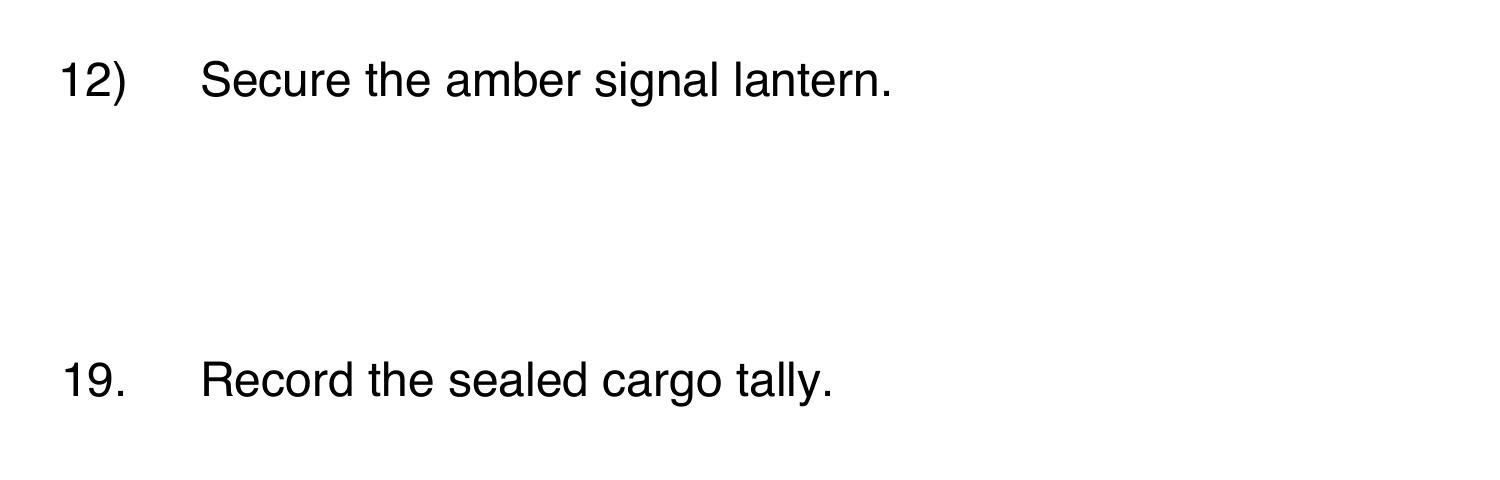
12) and 19. labels in that order. It was frozen before candidate output was reviewed.4., 7), and the independent 12) then 19. pair.
The same labels and delimiters are present in retained Tesseract TSV rows.
The original controls rewrote both 4. and 7) as 1.. The independent pair had not previously run.
4\., 7\), and 12\) … <br> … 19\..
4., 7), then separate 12) and 19. lines, with no generated counter or added bullet.
The five planned product conversions ran once in 7.01 seconds. Every conversion and PDFMD integrity check completed successfully. The two original controls preserve 4. and 7); the independent positive control preserves 12), 19., their order and the visible item break. Browser inspection of the actual converter output confirms those four lines and finds one explicit break with no generated list element in the mixed-delimiter control. Tesseract 5.5.2 used English data at 216 DPI with page segmentation mode 3. The change is confined to the canonical emitter; it changes neither OCR-provider nor renderer code. The existing human renderer passes the emitted literal <br> through.
Remaining source failures. On the affidavit page, the provider still omits the 5 from 45. and the footer 8 and splits 37.; downstream output retains those errors. Separately, canonical and human output fragment 11 source paragraphs into 44 blocks and omit all six meaningful bold spans. Both new controls emit their titles as paragraphs instead of headings and omit title bold; their source font sizes and alignment remain unasserted. The negative control also loses the relation between its physical wrap and one logical paragraph. The positive control retains each marker-to-body relation and source order. Independent review confirms that the three Unit 31 boundary spaces remain present in this packet and that the marker change introduces no other output delta on those pages.
A supporting raster regression also invoked one real OCR call before the fixed five-case batch. That extra call passed its narrow hybrid-page assertions, but no raw provider transcript or complete conversion output was retained. It is disclosed separately and is not part of the five measured source cases or evidence for marker acceptance.
The independent evaluator made no recognition or provider calls and accepted only the bounded marker correction. It kept the numeric-prose control, English recognition and deployment failed. Read the retained marker summary and source/output hashes.
1e6d5a6 is not deployed, and this report changes no recognition code or production behavior.Prior local candidate · Unit 31 word boundaries
The source and Tesseract already separated these words. The baseline emitter joined them when their boxes overlapped. Candidate 1d850f964930da92256437005bb0ac4c291c4171 preserves documented provider word boundaries while retaining the existing native-fragment spacing behavior.
of Tomsa. lost its space in PDFMD; the second occurrence was already correct. The crop retains the source pixels without retouching.of Tomsa.ofTomsa.of Tomsa.CONTROL /CONTROL/CONTROL /4.1.1. — still wrong in Unit 317)1.1. — still wrong in Unit 31Both canonical PDFMD and human Markdown restore the three spaces: one on the affidavit page and one in each of the two controls. The three fresh product conversions ran once with English Tesseract 5.5.2, PSM 3 and PDFium rendering at 216 DPI. All raw TSV files are byte-identical to the retained baseline, so a different OCR reading does not explain the improvement. No dictionary, new model or high-resolution refinement was used.
Independently authored controls preserved amber ledger. across overlapping word boxes, kept the native fragments of Recast: ok. joined correctly, and left the single OCR word rivet. unsplit. Two existing note-call placements also remained correct. The character-box control tests the evidence contract; this Tesseract adapter does not populate those boxes in real conversions.
Read the retained review summary and artifact hashes. Per-call wall timing and review effort were not measured; worker conversion times are recorded separately in that summary.
Limits. The affidavit still loses the source digits in 45. and the footer 8, splits 37., omits six semantic bold spans and fragments 11 logical paragraphs into 44 blocks. The two control markers still become 1., and their style/furniture omissions remain. Three pages and deterministic component controls do not verify the full 20-page affidavit, broader English, or unknown provider granularity. The historical refinement candidate below was not retested.
Exact source-to-output trace
Tesseract 5.5.2 read bitmaps rendered by pypdfium2 5.9.0 and PDFium; PDFMD selected and applied the replacement.
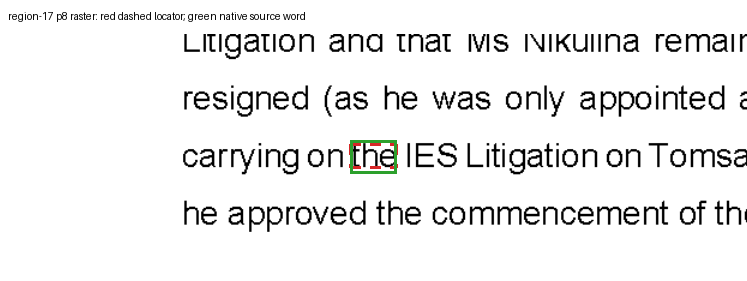
carrying on the IES. Select the image to inspect it at full size.carrying on the IES
The ordinary pass emitted separate on and the tokens.
A resampled full-page pass emitted one wider token: onthe. Upscaling a 200-PPI page image added no optical detail.
The adapter replaced only the; the earlier on survived, producing carrying on onthe IES.
Correct raw reading
carrying on the IES
Canonical result
carryingon ontheIES
Whole retained refinement census
Before refinement, 15 of 27 target readings were exact. After refinement, 11 were exact: 10 gains, 14 losses (11 direct lexical losses plus 3 neighbor duplications), 2 wrong-to-different-wrong changes, and 1 net-zero chain. None of the 23 affected complete text units was fully source-faithful.
Historical adoption audit
An earlier refinement implementation was deployed on 6 September after 442 tests passed and a six-page D03 check was reported source-exact. That checker extracted only ASCII letter and number runs and case-folded them, so punctuation and case were outside its “exact” result. Two refinement-focused tests covered raw-token retention and rejection of an I-to-l substitution, but not a candidate overlapping multiple correct words.
The independent review cited different final artifacts from the later passing gate, so independent acceptance of that exact final candidate is unproven. This does not show that the VNAT defect was knowingly shipped. The production revision inspected for this report, dd16e65, has basic OCR configured at 216 DPI and does not contain or invoke the refinement module. The historical audit itself ran no new conversions. The bounded local comparison below measures current-code output on three pages.
Required progression
Each step needs exact source comparison, independent controls and complete-document and generalization checks, independent review bound to final artifacts, and a verified public report before its dependent step starts. A failed check keeps it blocked.
Preserve correct raw characters and word boundaries through adapters, refinement, canonical PDFMD, and human output.
Only after conservation passes, test whether a dictionary-supported alternative is needed. No dictionary component has been selected or implemented.
Recover exact italic boundaries while preserving accepted text and regular-text confounders.
Recover exact bold boundaries without regressing accepted text or italics.
Resume paragraph, list, note, and other dependent recognition only after the earlier foundations pass.
Bounded baseline result
Using production revision dd16e65, three local English-only 216-DPI cases and one 200-DPI provider comparison ran once. The product cases were one affidavit page and two synthetic controls.
of Tomsa.of Tomsa.ofTomsa.CONTROL /CONTROL /CONTROL/4.4.1.7)7)1.On the affidavit page, raw and human text retain carrying on the IES. Raw OCR drops the 5 from 45. and the footer 8, and splits 37.. The direct 200-DPI result drops the 1 from 41. and the footer 8. It uses Poppler while 216 DPI uses PDFium, so the comparison cannot isolate DPI or show superiority.
Canonical and human output share the shown PDFMD errors. Both controls are source-exact in raw OCR after collapsing whitespace, including visible Quartermaster. All three cases then lose a word boundary in PDFMD. The affidavit’s 6 bold spans are absent semantically, and 11 source paragraphs become 44 blocks.
At this baseline checkpoint, the next identified problem was loss of raw OCR token boundaries during PDFMD emission. Marker rewriting is a separate blocked issue. Three pages do not establish complete-document or general English accuracy. Setup, path, and bookkeeping attempts failed; no completed OCR call was retried. The recognizer was unchanged.