Should have been recognized
carrying on the IES
Measured results · 10 September 2026
These are retained inputs from completed experiments. Each case shows the exact source image, the observed result, the independently defined expectation, the reason for failure, and the next decision.
Current decision
The baseline processed all 66 development pages—WS 13, VNAT 20, and IES 33—and produced structurally valid packages. All three document results were rejected after source comparison. Format validity is not the same as faithful recognition.
Case 1 · Text refinement
A higher-resolution OCR candidate contained the letters of the, but also merged them with neighboring on. The association step then attached that candidate to only one of the two base tokens it overlapped.
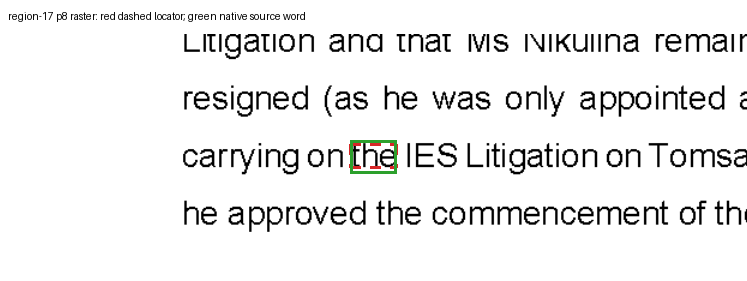
Should have been recognized
carrying on the IES
Recognized after refinement
carrying onontheIES
The candidate onthe overlapped the base tokens on and the, but replaced only the. The untouched on remained, producing on onthe. The same defect also produced a aresult and in inthe.
First prove that correct English text survives refinement and canonical emission. The association defect is one known mechanism, but correcting it alone cannot establish reliable text.
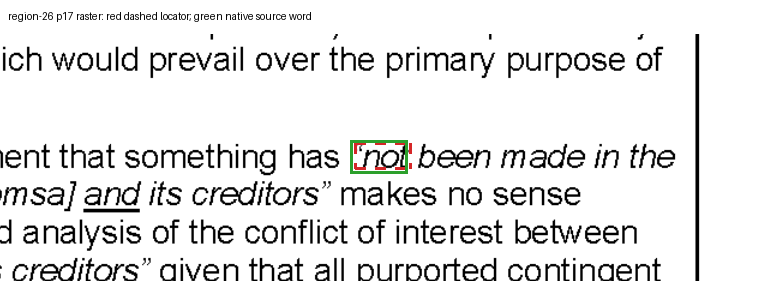
“not. The pipeline changed it to “nof, then back to “not: two edits, zero net gain.Case 2 · Scanned appearance
This retained excerpt contains upright paragraphs 97, 98, 100, and 101. Paragraph 99 and its three lettered subparagraphs are italic in the source. Exact span boundaries—not a vague impression of slant—are the acceptance target.
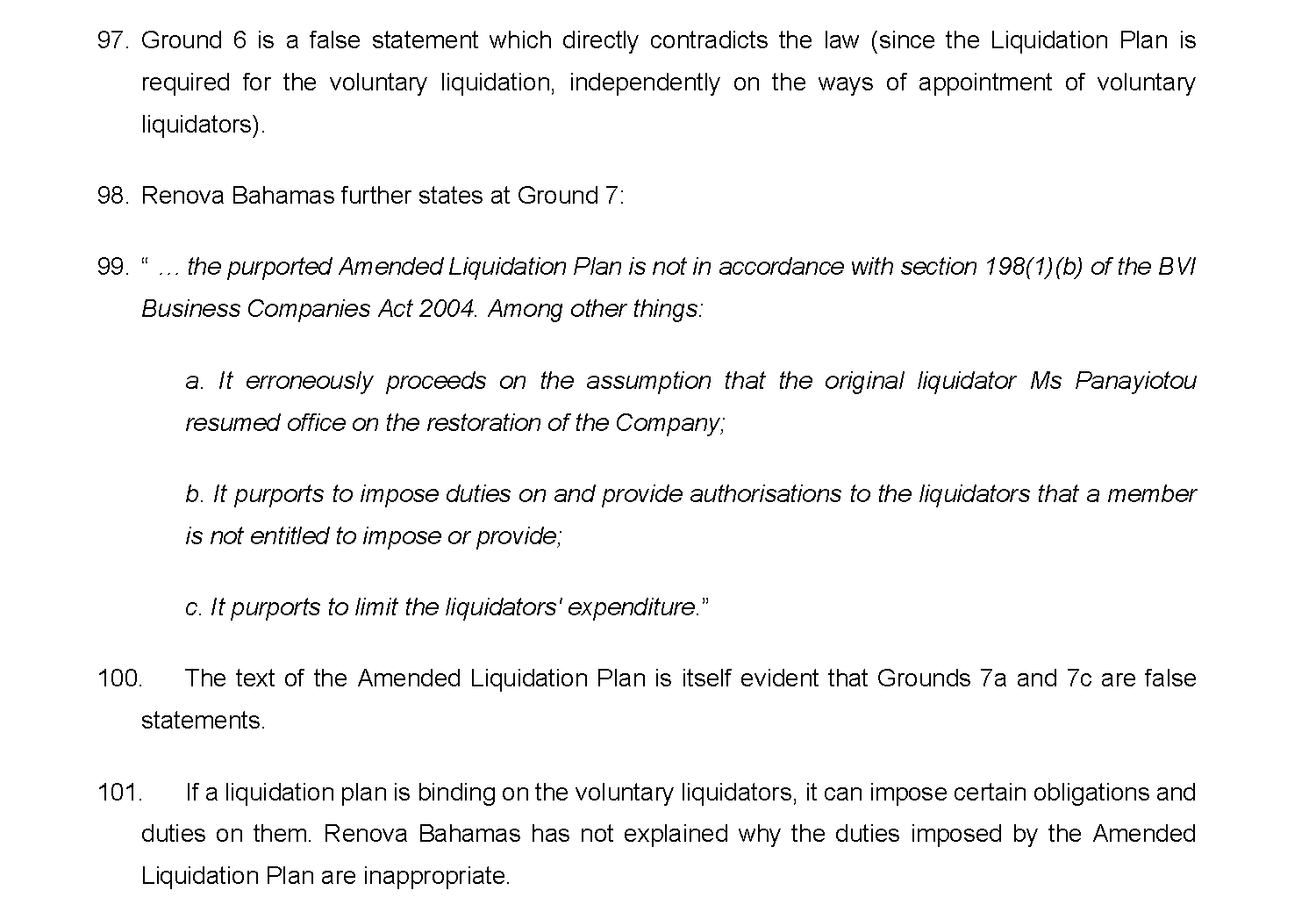
Should have been recognized
4 of 4 exact italic spans, with the neighboring text upright and the source wording unchanged.
What the candidates recognized
Cuneiform: 377 italic characters found, 3 missed, but 0 of 4 exact spans.
Tesseract: 1 italic character found, 386 missed, and 0 of 4 exact spans.
It supplied a strong character-level style signal, but changed the text: 17 omissions, 13 substitutions, and 1 addition across the excerpt. Fifteen source italic characters were therefore unavailable for an exact span, and three more were present but not marked italic.
Its text was closer—5 of 8 evaluated paragraphs were exact—but it almost never asserted italic style. Better text alone could not recover the required appearance spans.
Case 3 · Note identity and linkage
This page is a deliberately simple synthetic positive control: one raised call in the body and one matching note at the bottom. It tests the smallest useful footnote relationship without relying on a confidential document.
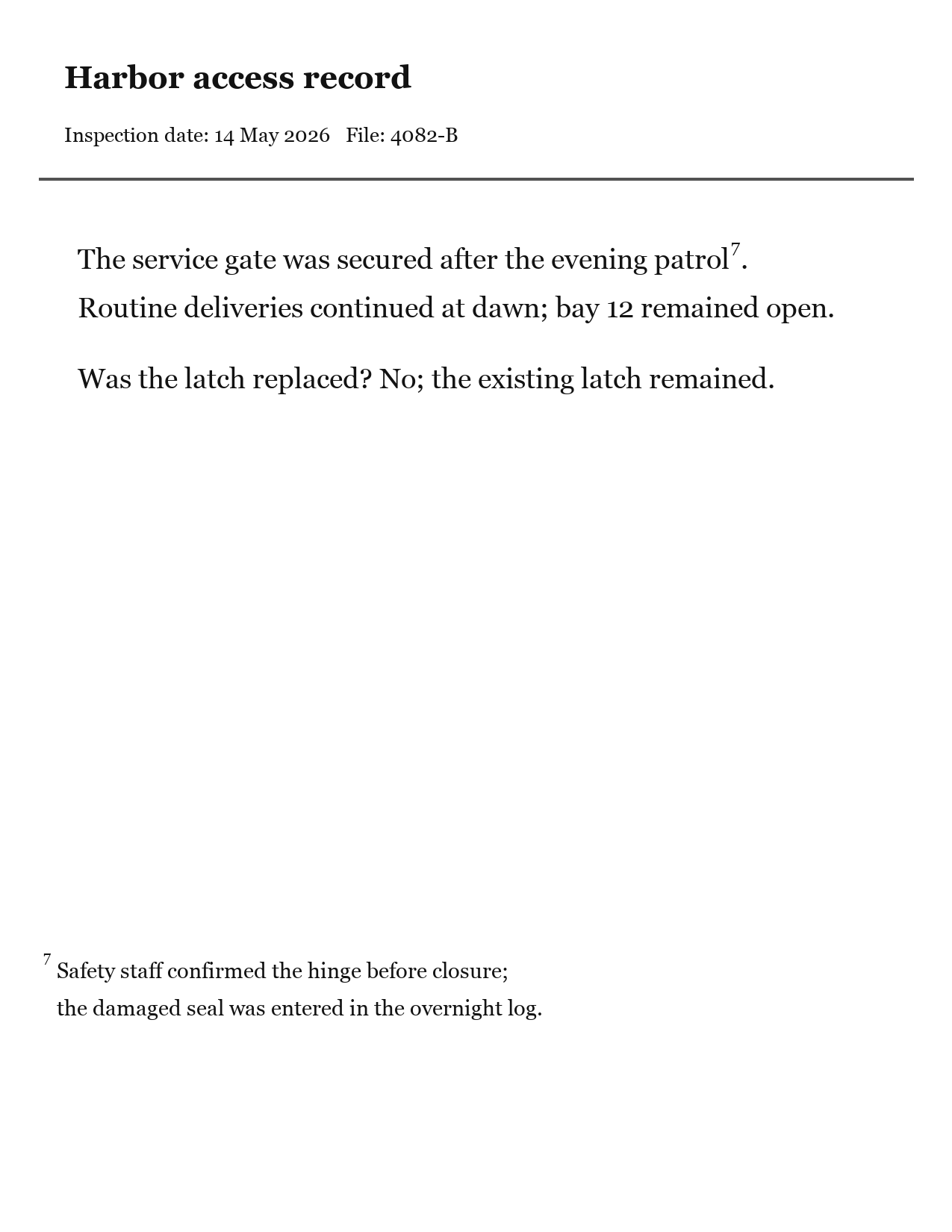
Should have been recognized
The service gate was secured after the evening patrol7.
A note object named note-7, linked from character offset 53, containing: “Safety staff confirmed the hinge before closure; the damaged seal was entered in the overnight log.”
Recognized output
The service gate was secured after the evening patrol’.
7 Safety staff confirmed the hinge before closure;

the damaged seal was entered in the overnight log.
The note was split into ordinary paragraphs. No call identity, note identity, parent, offset, or relation was emitted.
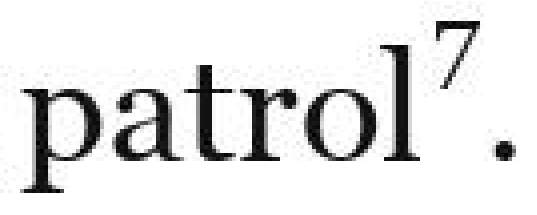
Zz. The lower label read 7 in both modes.Geometry found a plausible raised call and lower label, but geometry cannot prove glyph identity. The reader did not identify the tiny upper mark as 7, and pair similarity of 0.7882 was insufficient to assert a semantic link safely.
The geometry experiment was rejected: 0 of 3 positive controls were recovered. Thresholds will not be loosened merely to force this example through, because that would create unsupported footnote links elsewhere.
Proposed plan · next bounded unit
Use two control families plus one isolated VNAT candidate. Define expected outputs before changing the adapter.
Implement one rule: a selected OCR candidate must map cleanly to all base tokens it replaces. Ambiguous many-to-one or partial-overlap proposals abstain.
Check exact output, neighboring tokens, diagnostics, and the no-change path. Stop immediately on any regression or hidden duplication.
If Unit 28 passes its local controls, authorize a full VNAT run as a new decision. Do not mix that cost or evidence into the adapter repair.
WS, VNAT, and IES must all pass their source-based completion gates before Simon Hall is evaluated.
Provenance
The files above are direct copies of retained experiment inputs or source-review crops. They were not resized, redrawn, or recompressed for this page.
331daca5efbf57155688468c47504bc69294ff4861343a655aa5c2ca1fb2a4047e8d65f4465920d98561b1badf387af9e6c8f349b4b57944d1fa5a7a3b053799d2e348324f1cb2a992195a5050ca9c12f5d34a79c3e581facdf71dae0150d2c77288d39a35c11d6e6ff14bc7f4e7a70beb7847ad0f66cc5516a1e8f82ecb0b151b7d60858f7ffaba82c03645a5153b1be98ba4d496a8d99ab31b219b868d0818ee83eb5bbb2b05fd762402c8ad8214a54a3b46637925c0dcd8dfe8abc85ecf8418356059d277b4988000adbae0868d904aaff91fac9c8893f01d3ce75c2565a1a68ed24572e25bafb817e00584a1f69f895e7f0e965b62511e7180ee6d275e40